Most Building-Science Consulting Is a Stamp. High Performance Needs Something Else.
For the last two weeks I've been making a case: a high-performance home really comes down to two numbers — airtightness and ventilation — and while code addresses both, it sets the bar well short of what real performance takes.
Which leaves an obvious question hanging. How do you actually hit the numbers that deliver real comfort and durability?
It takes a different kind of consulting than most projects get.
There are basically two ways to engage with building science.
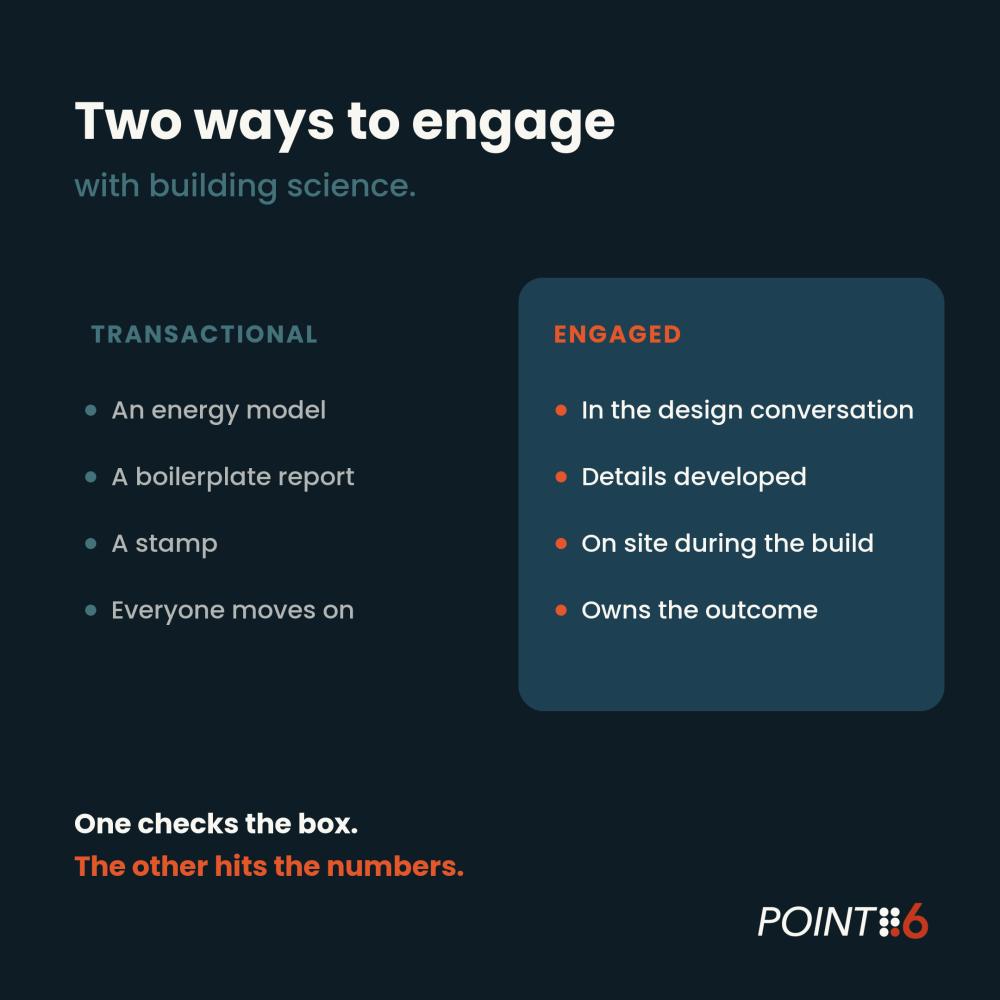
The first is transactional — building science as something you order, not something you do. You send out for an energy model, you get a boilerplate report and a stamp, and everyone moves on. It clears the threshold. It checks the box. For a project that just needs a number to pass, that's fine — plenty of people will sell it to you, and it's cheap.
The second is rarer — and it's the one your project actually needs. At Point 6, we get to know your project. We're in the design conversation early, while decisions are still cheap to change. We develop the details. We show up on site while it's being built. And we stay on it through verification — we own the outcome, not just the document.
We call it the custom-home standard of consulting, because that's what it is.
And the difference ties straight back to those two numbers. Airtightness and ventilation don't happen in a report. They happen in a thousand small decisions — on paper and in the field — and they fall apart in the handoffs. The gap between the wall section the architect drew and the wall the crew actually built. The duct run that looked fine in the model and got value-engineered on site. A stamp can't catch a detail that won't build. A person who's been with the project since feasibility can.
That's the whole game in high-performance work: closing the gap between what was designed and what gets built. You don't close that gap with a thicker report. You close it by being there.
And this isn't reserved for trophy projects. Building science keeps advancing — in airtightness, in ventilation, in how we model and verify what a building will actually do. But a project only captures those gains when someone carries them from the design table into the field. Every building deserves that level of attention. The commodity model leaves the value sitting on the table; the engaged model is how a project actually realizes it — the comfort, the durability, the performance it was designed for.
That's the part that's hard to see until it's too late. Nobody decides to build a worse building. It just slips away, one unsupported handoff at a time.
Architects and builders doing high-performance work — what do you actually want from a consultant on a complex project? And where have you watched the handoff between design and build break down? I'd like to hear it.