
A Building Designed to Perform Is Not the Same as One Confirmed to Perform
Every high-performance home starts with good design. And design matters — more than almost anything else we do. Get the orientation, the envelope, and the mechanicals right on paper, and you've set the ceiling for how well that building can ever perform.
But a beautiful set of plans is only part of the equation.
We can model a home that hits every high-performance number on paper. Airtight envelope. Right-sized mechanicals. Heating demand a fraction of the house next door. Looks great in the file.
But a model is a promise. A prediction about a building that doesn't exist yet.
And here's what we keep coming back to: the whole job is turning that promise into proof.
That's what this quarter is about. Not "trust us," not "we use good details" — proof you can measure, document, and hand to an owner.
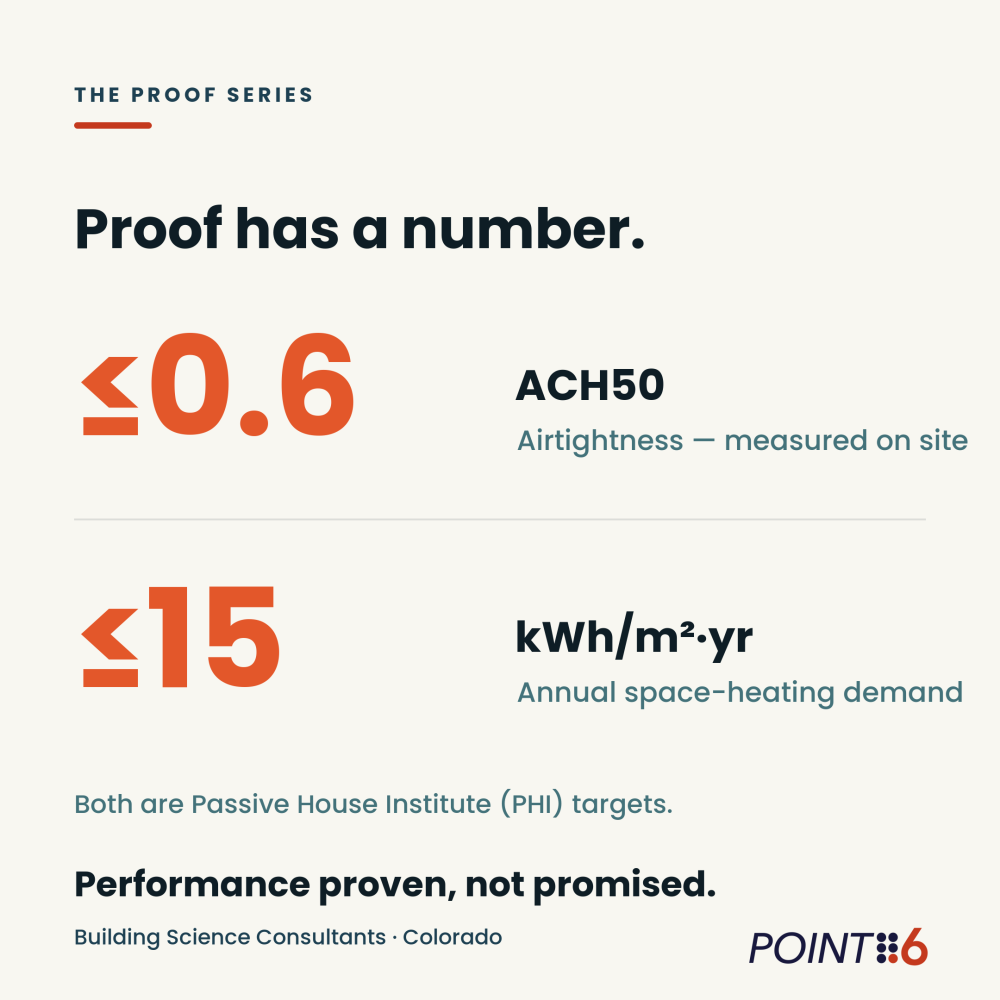
In our world, proof has a number.
Airtightness at or below 0.6 air changes per hour at 50 pascals — the Passive House standard, confirmed with a blower-door test on a real building, on a real day. Space-heating demand at or under 15 kWh per square meter per year — roughly 75–90% less than a code-built home.
But the numbers aren't the point. They're just how we prove the things that actually matter: comfort you can feel in January, walls that stay dry and durable for decades, air that's healthy to breathe, energy bills that don't sting.
That blower-door number is a receipt.
When it comes back clean, it's not luck. It's because somebody mapped the penetrations during design, spec'd the right materials, sequenced the work, and held the line when the schedule got tight. The test doesn't create the number. It confirms what the crew already earned, months earlier.
And when it doesn't come back clean? That's proof too — proof of exactly where to look, while there's still time and money to fix it.
That's the difference we want to sit with this quarter. Plenty of buildings are designed to perform. Far fewer are proven to. Designing a high-performance building and confirming it performs are two different jobs — and the second one is the one most projects skip. It's the one we don't.
Over the next few months we'll show you the real stuff. Actual details, actual test days, actual fixes from the field — performance proven, not promised.
Glad to have you along.
So here's our question, and we mean it most of all for the skeptics: when you hand a project over, what's your proof that it performs the way it was designed to — or is it still mostly trust? Tell us. No sales pitch, no jargon. We'd genuinely like to hear it.

Sources: Passive House Institute (passivehouse.com) — 0.6 ACH50 airtightness; 15 kWh/m²·yr heating demand; 75–90% less heating/cooling energy than a code-built home.